


Across every growth-stage organisation we work with, the same failure shows up in different clothing. Ambition scales in months. The operating model built to execute it does not.
The result is rarely a strategy problem. It is a capacity problem, and it is almost always invisible from the top until it becomes expensive.
Key findings
- Growth adds complexity faster than most operating models can absorb. More customers, larger teams and new markets each introduce additional decisions, interdependencies and performance data to manage.
- The gap is rarely visible from the top. Leaders typically see slower decisions and missed deadlines long before they see the structural cause behind them, because headline growth numbers keep climbing while the underlying friction accumulates quietly.
- Extension feels safer than redesign, and consistently costs more. Adding headcount, tools or markets on top of an unchanged process leaves the original constraint in place. It postpones the problem rather than solving it.
- Decision rights are usually the first thing growth breaks. What worked when one person made every call becomes a bottleneck the moment the organisation adds a second market, a second product line or a second layer of management.
- Reporting and data are typically the last function to be redesigned, and the first to fail. Processes built for one market or one team size rarely survive a second one intact, and the failure often surfaces as a trust problem before it is diagnosed as a design problem.
- Sustainable scaling starts with a diagnosis, not a tool purchase or an org chart reshuffle. Organisations that scale well ask what the operating model needs to look like at the next stage before they change anything.
The execution gap
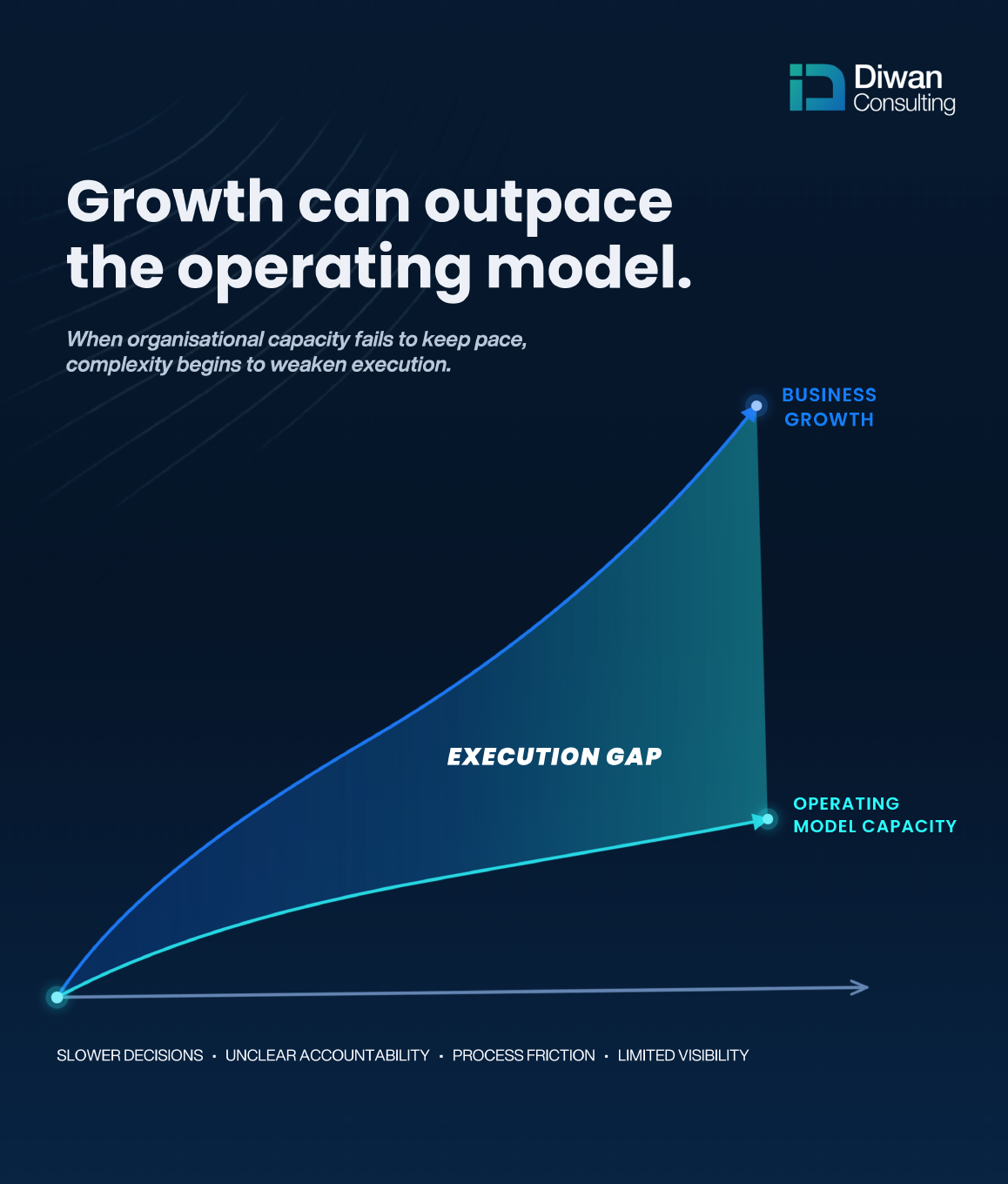
As companies expand, operating complexity does not remain constant. More customers, larger teams and new markets introduce additional decisions, interdependencies and performance data to manage.
Operating practices that were effective at one stage can become constraints at the next. Informal decision-making begins to slow execution. Responsibilities overlap. Processes designed for lower volumes become less reliable. Performance becomes increasingly difficult to track.
The issue is not simply operational inefficiency. It is a growing gap between commercial ambition and organisational capacity, a pattern we refer to at Diwan Consulting as the execution gap.
Closing it requires leaders to determine whether strategic priorities remain clear, decision rights are explicit, critical processes can absorb higher volumes and performance data supports timely action. Sustainable scaling begins when the operating model is redesigned for the next stage of growth rather than simply extended from the previous one.
Why the gap stays invisible until it is expensive
The execution gap rarely announces itself. Revenue is usually still climbing, new logos are still closing and the headline numbers still look healthy, which is exactly why the underlying strain goes unaddressed for so long. Underneath a growing top line, informal habits harden into unwritten culture, personal relationships substitute for defined process and a small number of senior people, often including the founder, quietly absorb the slack that the structure itself should be handling.
That absorption is the most dangerous part of the pattern, because it works. For a while. It masks the gap precisely by preventing it from showing up in performance, right up until the people absorbing it hit their own limit, a key hire leaves, or the organisation adds one more market, one more team or one more product line than the informal system can quietly compensate for.
By the time the gap becomes visible in the numbers, in slipped deadlines, in quality issues, in a strong external hire who cannot get traction, it has usually been building for several quarters. The cost of fixing it at that point is materially higher than the cost of diagnosing it earlier, because the organisation is now solving a crisis rather than executing a plan.
Extension versus redesign
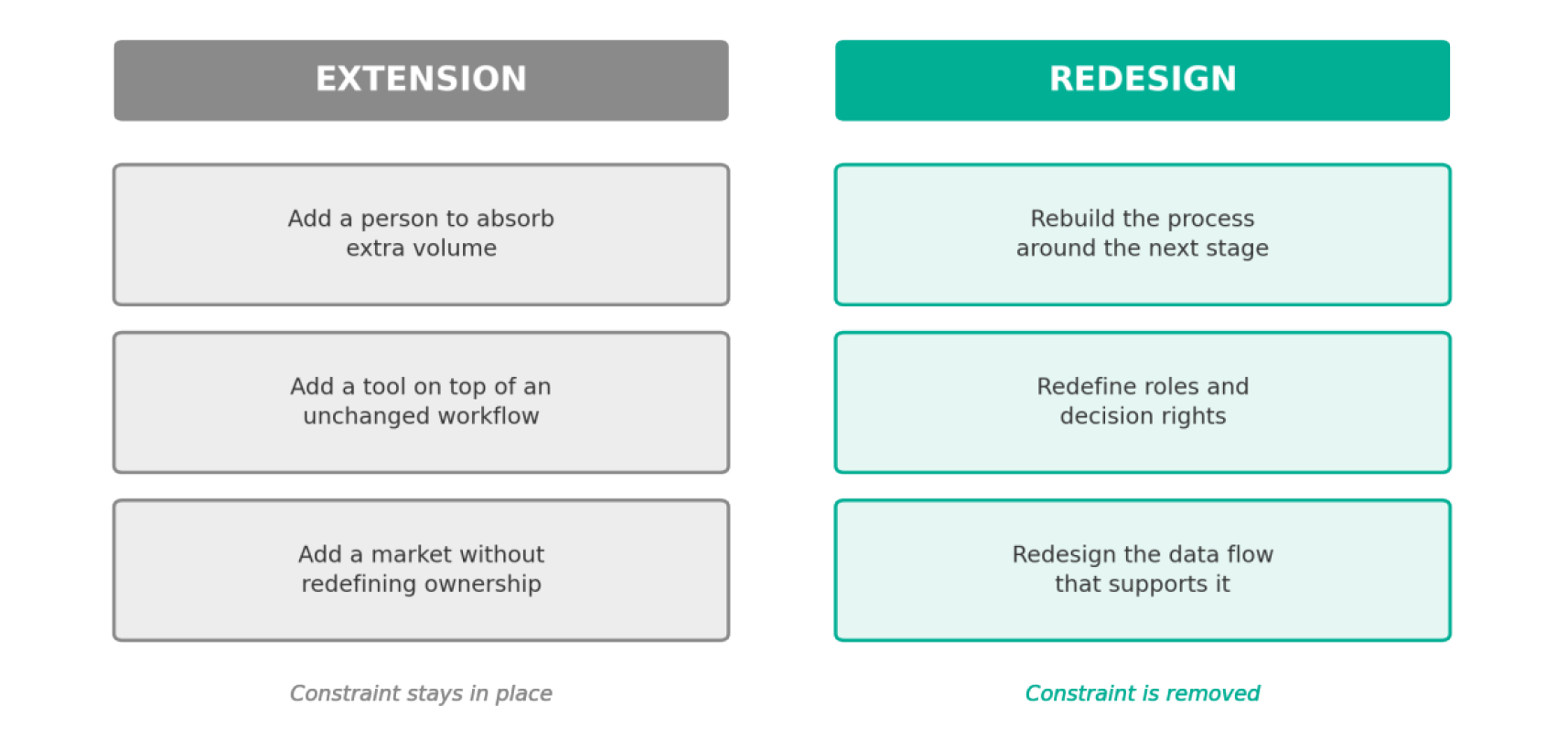
When growth starts to strain the operating model, the instinctive response is almost always extension: add a person to absorb the extra volume, add a tool to speed up the existing process, add a market without redefining who owns what. Extension is faster to approve and less disruptive in the short term, which is precisely why it is the default response.
The problem is that extension leaves the original constraint exactly where it was. A second person added to an undefined process now produces the same ambiguity twice as fast. A tool layered onto an unclear workflow accelerates the confusion it was meant to resolve. A new market added without redefined decision rights simply doubles the volume flowing through a bottleneck that was already under strain.
Redesign asks a harder question first. Given where the organisation is going over the next stage of growth, not the stage it is currently in, what should the operating model actually look like. Only once that is answered does it make sense to decide which tools, roles and processes get it there. Redesign takes longer to plan and is more disruptive to implement. It is also the only one of the two paths that removes the constraint rather than multiplying it.
Four questions that reveal the gap
Closing the execution gap starts with an honest answer to four diagnostic questions, applied at the level of the specific function or team under strain rather than the organisation in the abstract.
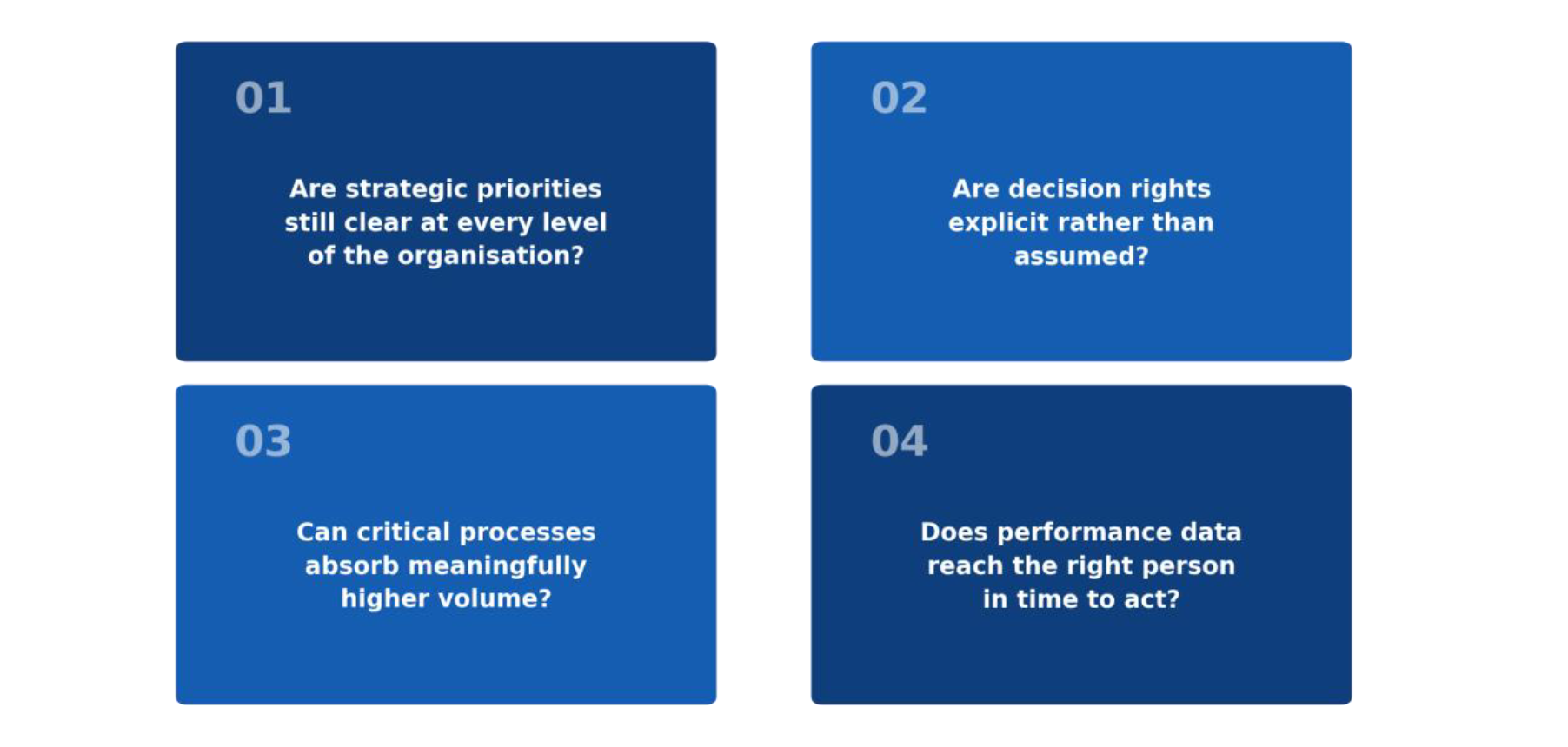
Are strategic priorities still clear at every level of the organisation
A priority that is clear to the leadership team but not to the people executing it produces the same symptom as no priority at all: local decisions that technically make sense but collectively pull in different directions.
Are decision rights explicit rather than assumed
Where a decision right was never formally assigned, it defaults to whoever historically made that call, usually a founder or an early hire. That default becomes a bottleneck the moment volume exceeds what one person can personally review.
Can the organisation's critical processes absorb meaningfully higher volume without breaking
A process that works at ten transactions a week and quietly degrades at fifty was never actually validated for growth. It was validated for the volume it happened to be tested against.
Does performance data reach the right person in time for it to change a decision
Data that arrives after the decision it should have informed is not a reporting problem. It is a structural one, and it usually means the reporting process was never redesigned for the number of people or the number of markets now generating it.
Where the answer to any of these is no, the constraint is rarely solved by working harder within the existing structure. It is solved by redesigning the structure itself for the stage of growth the organisation is now entering.
Patterns we see across growth-stage organisations
Across our client engagements, the execution gap tends to show up in a small number of recurring, recognisable patterns.
- The founder bottleneck. A founder or senior leader who once approved every decision personally becomes the ceiling on how fast the organisation can move, long after the team around them has grown well past the point where that made sense.
- The silent overlap. Two roles are added in response to growth without redefining scope, so both quietly assume responsibility for the same decisions while neither owns the ones that fall between them.
- The channel that outgrew its process. A sales or acquisition channel scales faster than the team responsible for qualifying, routing and reporting on what it brings in, producing volume the organisation cannot actually convert or service well.
- The reporting lag. A performance reporting process built for one market or one team size keeps running after a second market or team is added, quietly producing numbers that are technically accurate and practically too late to act on.
None of these patterns is a failure of effort or talent. Each is a structural mismatch between the operating model an organisation built at one stage and the stage it has since grown into, and each is solvable once it is correctly diagnosed.
A Diwan Consulting perspective
This is the problem the SCALE Canvas™, Diwan Consulting's proprietary methodology, is built to diagnose. It maps an organisation's current operating model against five dimensions and translates the findings into a prioritised transformation roadmap rather than a generic list of recommendations.
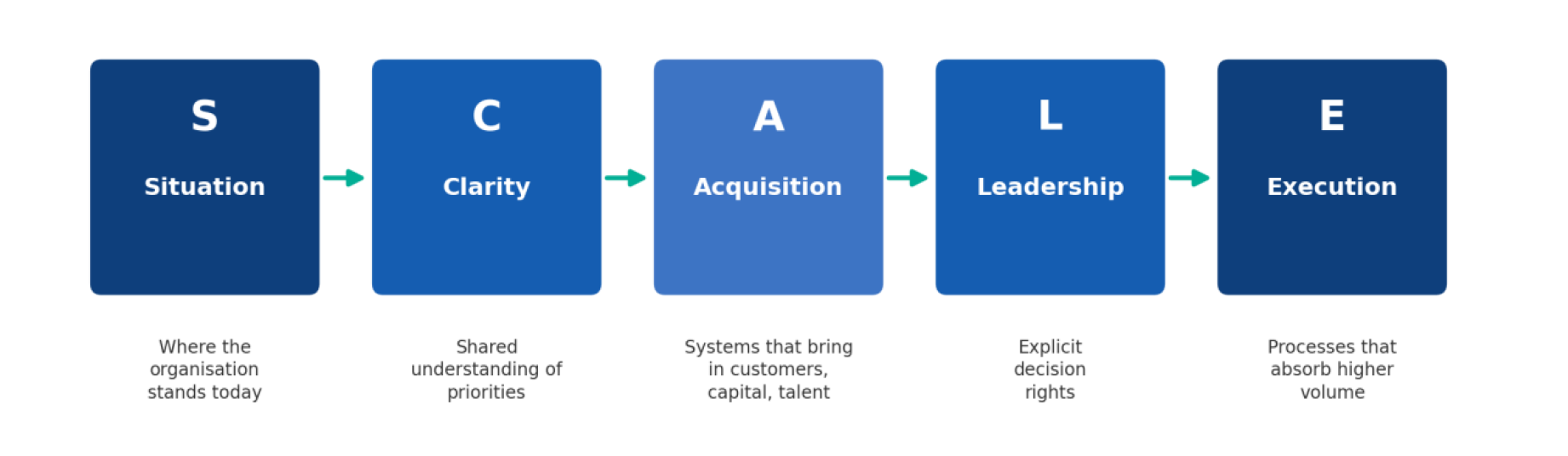
Situation
A structured read of where the organisation stands today: revenue trajectory, team structure, decision flow and the specific points where volume is already outrunning process. This grounds the diagnosis in where the organisation actually is, rather than where its ambition assumes it to be.
Clarity
Whether strategic priorities are understood the same way at every level of the organisation, not only at the leadership table. Misalignment here is usually a clarity problem before it is a communication problem: a priority that was never precisely defined cannot be consistently executed, however well it is repeated.
Acquisition
Whether the systems that bring in customers, capital or talent were built for the organisation's current scale or for the one it has already outgrown. Growth frequently multiplies acquisition channels faster than the operating model that qualifies, routes and reports on what they bring in.
Leadership
Whether decision rights are explicit and distributed to the level where the decision is actually made, or still informally routed to whoever historically made it. This is the layer most exposed when a founder becomes the bottleneck, and it is almost always the dimension that unlocks the others once it is properly redesigned.
Execution
Whether critical processes and the data that supports them can absorb meaningfully higher volume without a proportional increase in errors, delay or oversight. This is where the cost of not redesigning becomes visible in the day-to-day performance of the organisation.
Growth is rarely limited by ambition. It is limited by whether the operating model was built for where the organisation is going, or only for where it has already been.
What leaders should do next
A small number of concrete actions consistently separate organisations that close the execution gap from those that let it widen as they grow.
- Diagnose before investing. Map where the current operating model is already under strain, rather than where it is assumed to be, before committing budget to a fix.
- Put a senior owner on the redesign itself, not just the rollout of whatever tool or hire follows from it. Redesigns that survive contact with the organisation are the ones a leader continues to actively own well past the kickoff.
- Redesign the workflow before adding headcount, tools or markets on top of it. Extension is faster in the short term and consistently leaves the underlying constraint in place.
- Make decision rights explicit in writing wherever growth has made them ambiguous, particularly where a single individual has become an informal bottleneck.
- Rebuild reporting processes at the same time as the workflows they measure, rather than after. A process redesigned without redesigning how its performance is tracked tends to drift quietly back to the old pattern.
- Revisit the diagnosis at each stage of growth. An operating model built for the current stage is, by construction, not built for the next one.
Where does your organisation stand on the execution gap?
Diwan Consulting runs a short SCALE Canvas™ diagnostic for growth-stage leaders who want a clear read on where their operating model is likely to break next.
Request a diagnostic